Signer #26, Hannah Plant, “Founding Mother”
Hannah Hunt Plant
Born: Circa 1794-6, Pelham, Westchester County, New York
Died: Circa 1874, Waterloo, Aged 78-80
Occupation: “Keeping House”
Local Residence: 100 William Street, Waterloo
The search for Hannah Hunt Plant (Signer #26) raised a question that, I have to admit, I never even considered. Did the signers of the Declaration of Sentiments have any personal contact with the Founding Fathers? Of course, by "Founding Fathers," I'm referring to the generation of Caucasian men credited with the war for American independence and the establishment of the United States.
The moniker "Founding Fathers" is itself comparatively recent, attributed to future president Warren G. Harding. Then a senator from Ohio, Harding introduced the term in a speech before the 1916 Republican National Convention. He had evidently been toying with the exact phrasing for years before landing on the pleasant alliteration and two-syllable-per-word, trochaic cadence of "Founding Fathers" ("Founding"). Harding's invention has been criticized since because of its explicit and subtle exclusions. What part did women play in the creation of America? What about people of color, who are implicitly omitted from the category?
Nonetheless, exploring connections between the Revolutionary generation and the Seneca Falls generation is of vital importance. For starters, the Declaration of Sentiments was devised as a modified or corrected version of the Declaration of Independence, where the wording of the former borrows directly from the latter. Recovering linkages between the Founding Fathers and Seneca Falls might also help to reveal a philosophical inheritance, which connects the American Revolution to the civil rights movements that succeeded it.
Ironically or unironically, Hannah Hunt Plant crossed paths with the founding father who has/had arguably the worst reputation, Aaron Burr. Plant, a native of Westchester County, probably became acquainted with Burr, who owned property and offered his services as an attorney locally around Westchester. Burr was a veteran of the Revolutionary War, but he is best known for killing Alexander Hamilton in an 1804 duel while serving as U.S. vice president. After Hamilton's murder, Burr was tried for treason, accused of assembling a paramilitary group and conspiring to launch a separatist insurrection against the United States. It is believed that Burr intended to create his new nation out of territory seized from southern states west of the Appalachian Mountains and from parts of Mexico. Gordon Wood describes Burr as “the most romanticized and vilified historical character in American literature…the subject of countless poems, songs, sermons, and semi-fictional biographies, and the central character in nearly three dozen plays and more than four dozen novels and stories” (281). And Wood made this observation before Burr ever played the heel in the musical Hamilton. Regarding Burr's reputation as a womanizer and schemer, Wood relates that “it was once said of Burr that the only virtue he ever had was not claiming any” (286).
Signer #26 would have encountered Burr long after his treason acquittal and a period of de facto exile in Europe. After repatriating to United States, Burr spent the closing decades of his life practicing law back in New York.
Hannah Hunt Plant is part of the large contingent of signers of the Declaration of Sentiments hailing from the Hunt family. The Hunts were a set of siblings who gradually migrated to Waterloo in the years leading up to the Seneca Falls Convention. The family ties that guided the Hunts westward together as a cohort is reminiscent of a similar phenomenon in the life of Joel Bunker (#94). Hannah Plant is the sister of Lydia Hunt Mount (#13) and Richard Pell Hunt (#69). Lydia’s daughter Mary E. Vail (#56) is Hannah’s niece.
The Hunts can be traced back to the village of Pelham in Westchester County, located north of New York City. Based upon the age she gave in various censuses, Hannah Hunt was born in Pelham between 1794 and 1796. She was the eldest of Richard Hunt's and Mary Pell's seven children. Her mother's family, the Pells, were the founding settlers of Pelham, from whom the village took its name (Hunt 80, Wilson 18). The James E. Hazard Index, a database of Quaker records maintained at Swarthmore College, reveals that Richard, Mary, and Hannah were affiliated with the Purchase Monthly Meeting, based in the nearby hamlet of Purchase.
Hannah's mother, Mary Pell, is the first link between Signer #26 and Aaron Burr. During the Revolutionary War, some members of the Pell family remained loyal to the British Crown. At the conflict's end, the American government stripped the Pells of land as punishment for refusing to support the war effort. The Pells sued to recover their confiscated property and were represented in court by Aaron Burr, attorney-at-law. Burr won them the lawsuit, but the plaintiffs received only monetary compensation from the government. Their land was not returned.
The Machiavellian Burr was not one to leave the matter there. As Polly Kreisman relates, Burr and his wife acquired the “very same 146-acre tract at issue in the lawsuit” in 1790, which they intended as the location of a summer home. It is said that Burr had the ulterior motive of constructing a thruway on the land and charging toll. Burr eventually deeded the property to his stepson, perhaps as a means of distancing himself from the obvious conflict of interest he had in this shady bit of land speculation ("Burr"). Hannah’s mother, Mary Pell Hunt, was a member of the aggrieved Pells of Pelham, victims of the post-Revolutionary legal wrangling and Burr’s consequent self-dealing.
Another legal skirmish between Burr and Hannah's family arose in 1820. Hannah's father, Richard Hunt, was the recipient of an 1820 subpoena issued by Burr. “You are commanded and firmly enjoined, that, laying all other matters aside, and notwithstanding any excuse, you be and appear in your proper person,” the subpoena insists. It commands Richard Hunt to stand before the justices of “the Supreme Court of Judicature of the People of the State of New York” on November 30, at 10am. There is a steep $250 fine for failure to appear.
The subpoena discloses that it pertains to a dispute between two litigants: plaintiff, James Jackson, and defendant, Robert Chew. The case surrounded a “Plea of Trespass & Ejectment,” which is legalese meaning that it involved land inheritance rights. Without Burr's further involvement, Jackson versus Chew was eventually argued before the United States Supreme Court and decided in 1827, cementing the language used in wills to designate the proper line-of-succession in inheritance (“Jackson v. Chew"). Jurist John Marshall served as chief justice of the Supreme Court in this decision; Marshall also happened to be the judge who presided over Burr’s trial for treason in 1807.

On Thursday, April 17, 1823, Hannah Hunt was married under less-than-ideal circumstances. She wed Henry Ustick Plant, and the couple's marriage notice was carried in New York’s Evening Post and The Spectator. Hannah’s sister Eliza Hunt also married one Benjamin Underhill in the same ceremony. The nuptials seem to have been motivated by the recent death of the “late Richard Hunt, Esq. of this city,” the brides' father.
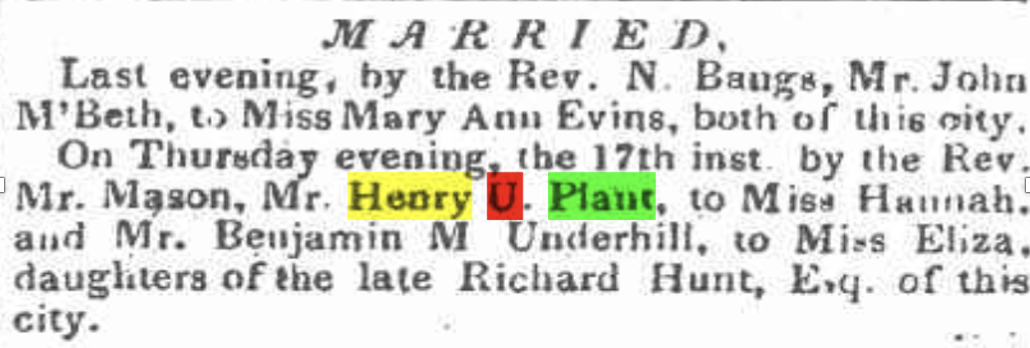
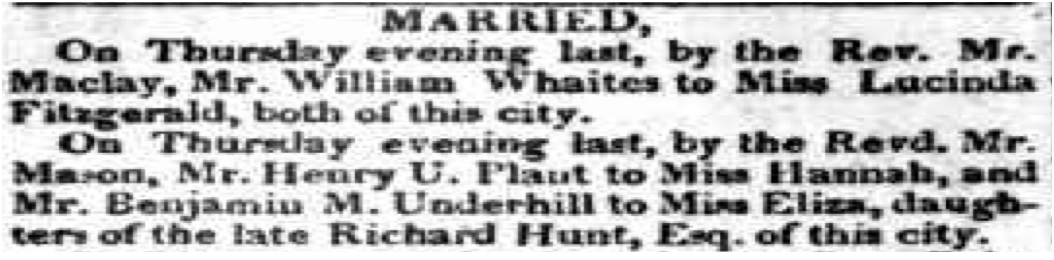
Hannah and Henry were married in the Methodist Church (“Hunt-Plant Marriage”). Swarthmore’s Hazard Project records that, because Hannah married a non-Quaker, she was formally disowned from the Society of Friends.
Henry Plant was a recent immigrant from Nova Scotia, Canada (“Henry U. Plant”). A passenger manifest for the schooner Abigale indicates that one H.U. Plant, a merchant arriving from New Brunswick, reached the Port of New York in August 1821. Hannah and Henry had a daughter, Henrietta Mathilda, around 1826-27. The Plants settled in West Farms, a neighborhood currently located in the Bronx.
Henry was now in charge of Hannah's financial affairs because marriage then legally entailed the redistribution a woman's property entirely to her husband. Under these circumstances, Aaron Burr re-inserted himself into their lives.
In 1828, Henry penned a letter composed “In Haste” to Hannah’s brother Richard Pell Hunt, who had already removed to Waterloo. Dated October 25, the letter is addressed from West Farms and details an encounter between Henry Plant and Aaron Burr. In a messy shorthand, Henry explains, “I had a conversation with Colonel Burr respect the amt due from Mr. Eaton’s estate to Your fathers. He requested me to wright to You for a power of attorney in my name in order that He might pay the money over to me. He Has funds in His Hands now and wants the thing brought to a close. You had better be on the alert for fear He may change His mind.”
The honorific “Colonel” reflects Burr's military service in the Revolutionary War, which included surviving the brutal winter of 1777-8 at Valley Forge. I could not ascertain the exact nature of the legal business at hand here—but it sounds like it has something to do with settling an estate. Or, it could involve money owed posthumously to Richard Hunt Sr. for his services as a lawyer. In any case, Burr seems impatient about seeing the matter to its conclusion. Today, signing over one's power of attorney essentially gives a second party the ability to represent an individual legally and make substantial legal decisions on their behalf without their explicit consent. Why is it necessary here?
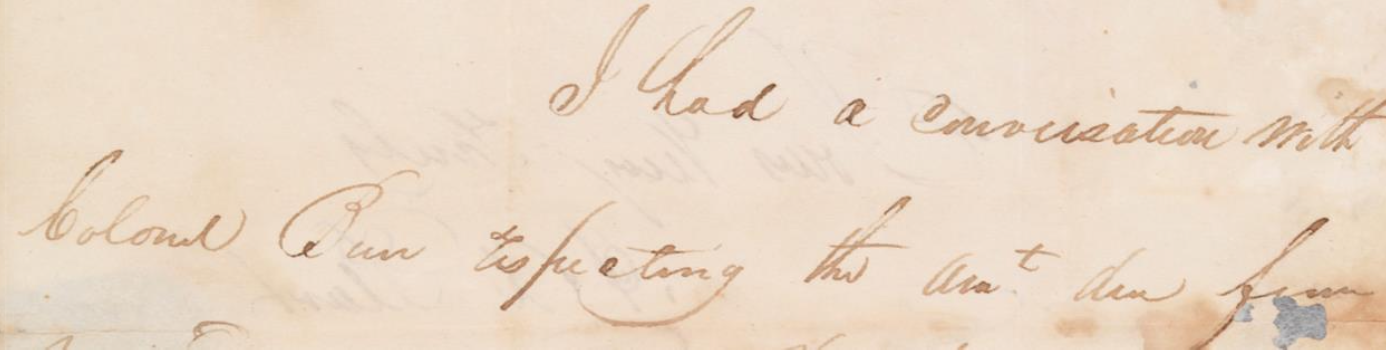
Henry closes the letter, “Hannah and Henrietta join me In Love to You all.”

Eight months later, Henry composed a second letter to Richard Pell Hunt recounting yet another conversation with Burr. On July 3, 1829—the eve of Independence Day—Henry writes, “Colonel Burr has been at our House this day and Stated that he had money plenty in his hands Belonging to the estate of Midcalf Eaton. And that as soon as I was duly authorized to reciev it [sic] he was ready to Sign date the debt in favour of father's estate. Therefor I think the sooner the thing is brought to a close the better while the old man is in the humour.” Henry's parting sentence closes with “Hannah Joins me in Love to You.”
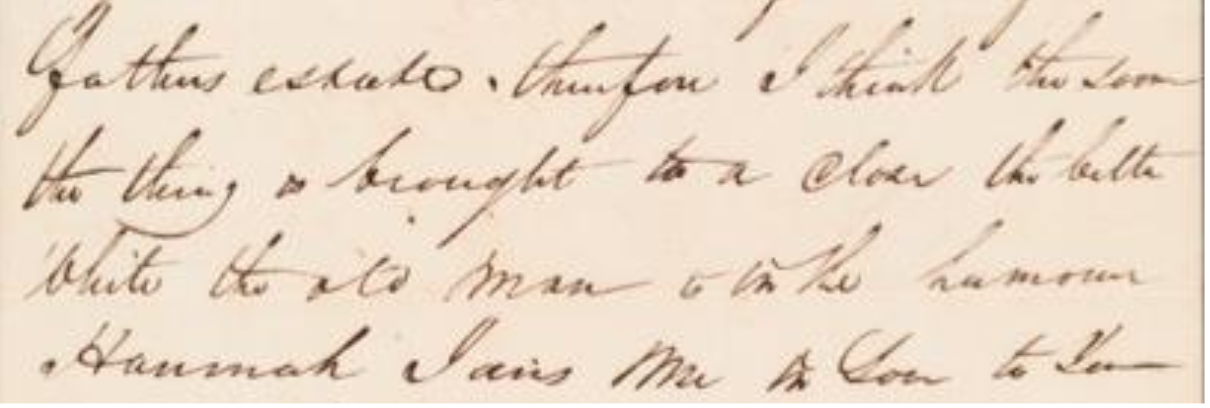 He adds another PS: “Please pay attention to the above as Burr is quite infirm.”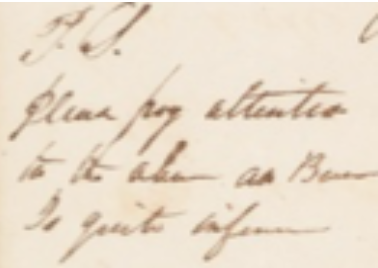
It is difficult to read about Burr's visit to the Plant household without considering his frequent characterization as a chronically insolvent ne’er-do-well. What was holding up the "money plenty" owed by Burr to Henry Plant from the mysterious estate of Midcalf Eaton? Was the matter so urgent that it required Burr to pay a personal visit to the Plants? As a transplant from Canada who was potentially unaware of Burr’s reputation, is Henry being naïve about the existence of the money and Burr’s willingness to fork it over? Is Burr just shining Henry on about the financial windfall, treating him as an easy mark to be duped and lied to for sport? I find Henry's implication that Aaron Burr could be volatile and temperamental revealing. Henry's seems eager to expedite matters while Aaron Burr remains in good humor for the time being.
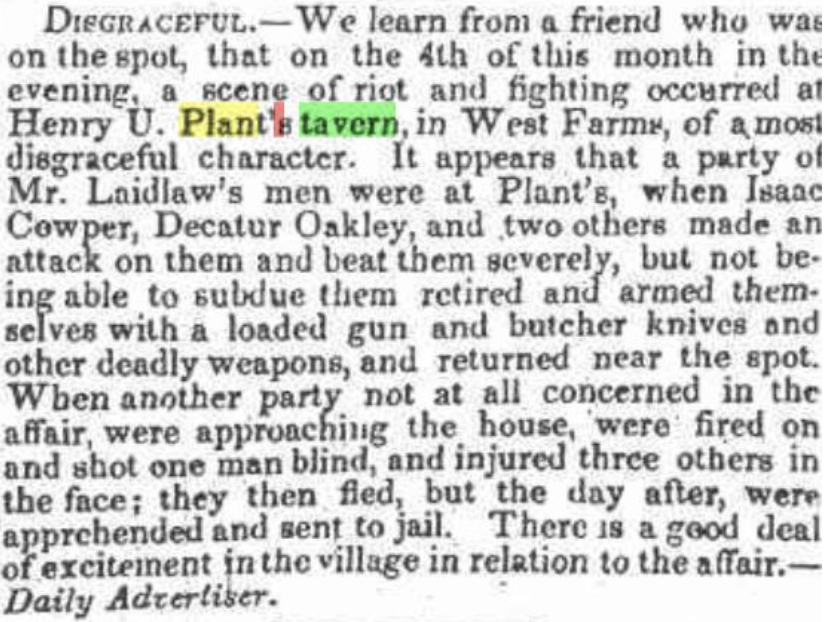
Some time late in the 1830s, the Plants left West Farms for Seneca County. An August 1836 news item reveals much about why they did so. An article entitled “Disgraceful” relates news about a bar fight and shooting that took place at an establishment owned by Henry Plant. “A scene of riot and fighting took place at Henry U. Plant’s tavern, in West Farms, of a most disgraceful character.” A rowdy party of hooligans confronted a rival group and “made an attack on them and beat them severely; but not being able to subdue them, retired and armed themselves with a loaded gun and butcher knives and other deadly weapons.” Fully armed, the assailants returned to Plant’s Tavern just as a handful of bystanders happened to be walking by. The armed men fired on the uninvolved party and “shot one man blind, and injured three others in the face: they then fled, but the day after were apprehended and sent to jail. There is a good deal of excitement in the village in relation to the affair.” Reportage of the violence was published in The Schenectady Cabinet, Albany’s Evening Journal, and New York City’s Spectator. The episode shows that Henry’s career as a bartender was, on occasion, very dangerous work.
 Henry U. Plant’s household appears in the 1840 census for Seneca Falls. It is listed on the same page that contains Henry's brother-in-law Randolph Mount and Jacob P. Chamberlain (Signer #88). Chamberlain occupies the line directly below Henry Plant.

Henry resides with an adolescent girl, Henrietta, and two adult women, Hannah and some other individual.
Just like Hannah Hunt Plant and Lydia Hunt Mount, another Hunt sibling followed Richard P. Hunt’s lead to Waterloo. Sister Mary Hunt wed Elijah Quinby, and the Quinbys eventually landed in Seneca County and joined the Junius Monthly Meeting. Elijah Quinby is said to have made his living by opening a general store for dry goods in Waterloo, an enterprise he undertook at the urging of Richard P. Hunt (Quinby 263-4).
Henry U. Plant died in Batavia, New York, on July 14, 1843, aged 49. He is buried at the Quaker cemetery on Nine Foot Road near Waterloo (“Henry U. Plant”). It is unclear if Hannah and Henry Plant accociated with Junius Monthly after Hannah’s expulsion from the Society of Friends in 1823. Henry’s burial at this location suggests that the Plants had reestablished some ties with the local Quaker community since moving from Westchester.
Henry died intestate, and Hannah is given “full power” over his property and debts in a probate letter filed that August in Waterloo. Later, a surrogate’s letter specifies that Henry, a resident of Waterloo, “died a natural death…at the town of Batavia in the county of Genesee.” An explanation for why Henry was in Batavia and the circumstances surrounding his death remain unknown.
The timing of Henry Plant’s death is remarkably close to that of Lydia Hunt Mount’s husband. Randolph Mount passed away just the year prior, in April 1842. This means that, by 1848, Hannah and Lydia were among the group of widows in attendance at the Seneca Falls Convention. They join Lavinia Latham (#58) and the best candidates for Phebe King (#35) and Betsy Tewksbury (#47).
Adding to this string of tragedies, Hannah’s niece Mary E. Vail also became a widow in the 1850s. Her spouse Gilbert Vail died in Keokuk, Iowa, in 1855. According to Judith Wellman, Richard P. Hunt provided his widowed sisters and other members of the extended family with monetary support (98). After the deaths of so many male breadwinners, the cluster of Hunt siblings around Waterloo acted much like a financial safety net among family members.
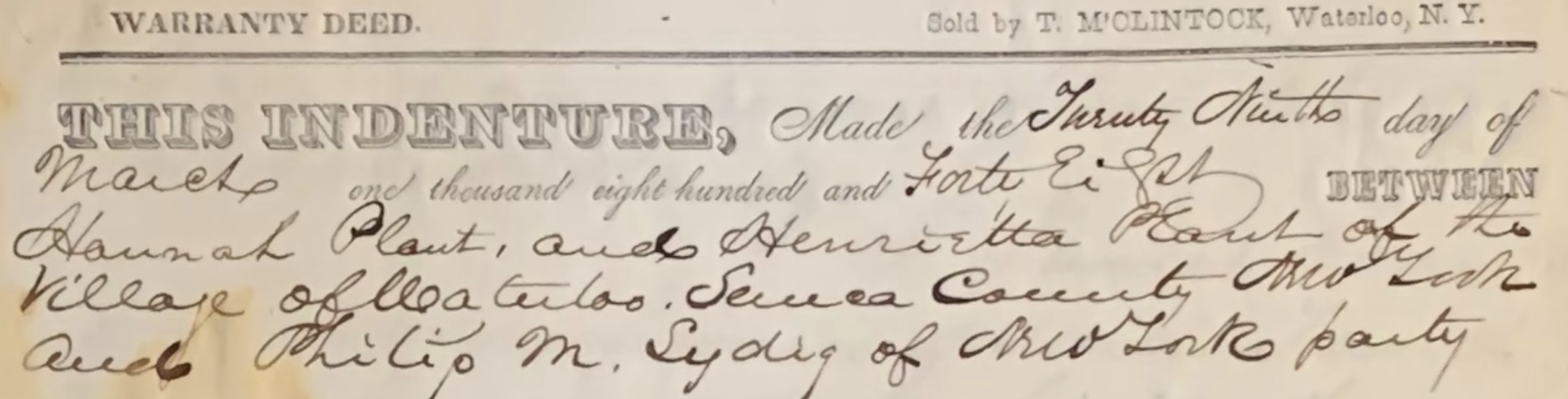
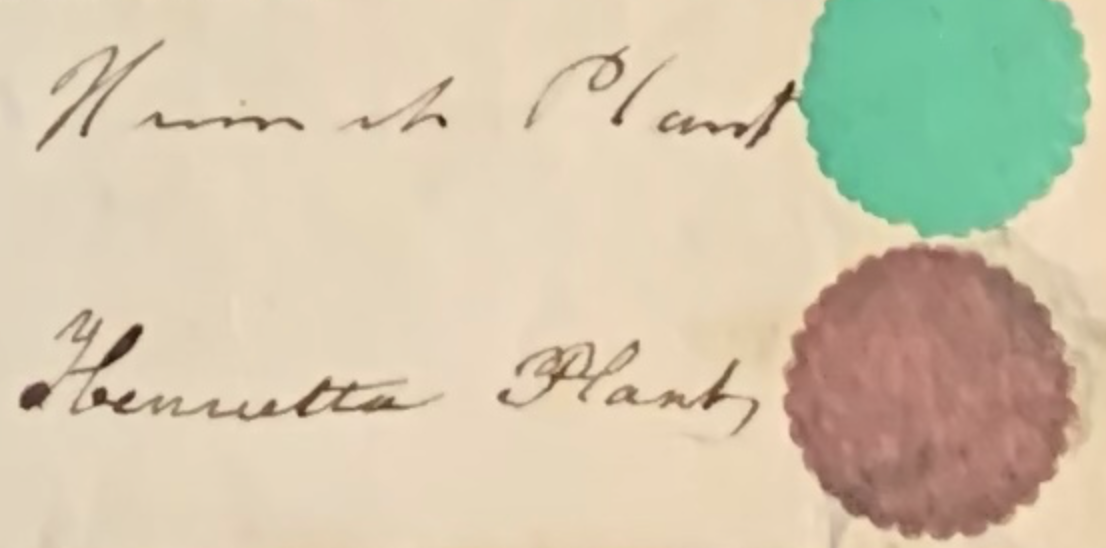
An artifact currently for sale online reveals the steps Hannah took to secure her financial future after the death of her husband. A "Mortgage Indenture" from spring 1848 bears the signatures and notarized seals of Hannah and Henrietta. The document attests that the Plants have agreed to sell a parcel of land in West Farms for the sum of $4,400. One Philip Lydig is the buyer. The tract had been paid off by Henry and Hannah in 1837 ("Mortgage"). Interestingly enough, the agreement is signed on legal stationery sold by Thomas M'Clintock (#86).
In an 1850 census record for Waterloo, Hannah and H.M. “Platt” live with Lydia Mount. Hannah is 55 and Henrietta is 23, and the mother-daughter pair is recorded as a second, separate family residing in the Mount household.
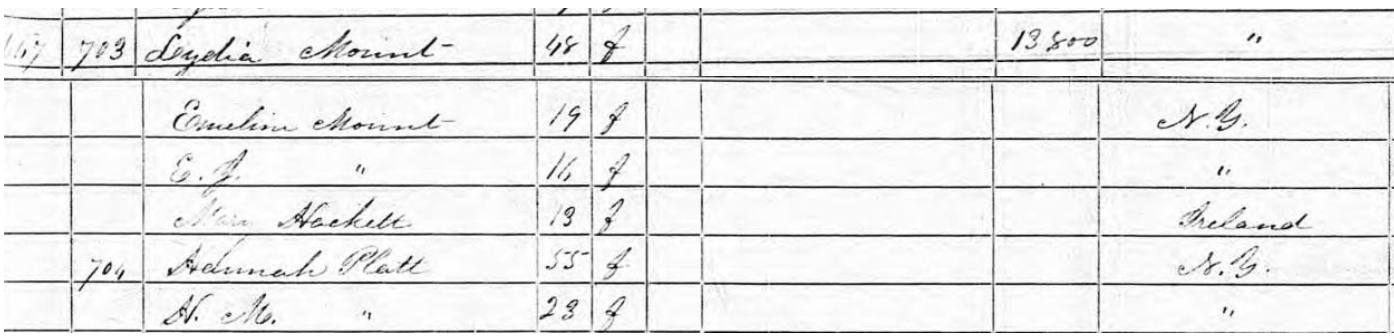
Hannah's living arrangements remain largely unchanged by the 1860 census. By this time, two of Lydia Mount’s daughters have moved out, and the recently widowed Mary E. Vail has moved back in along with her children, Caroline and Walter.
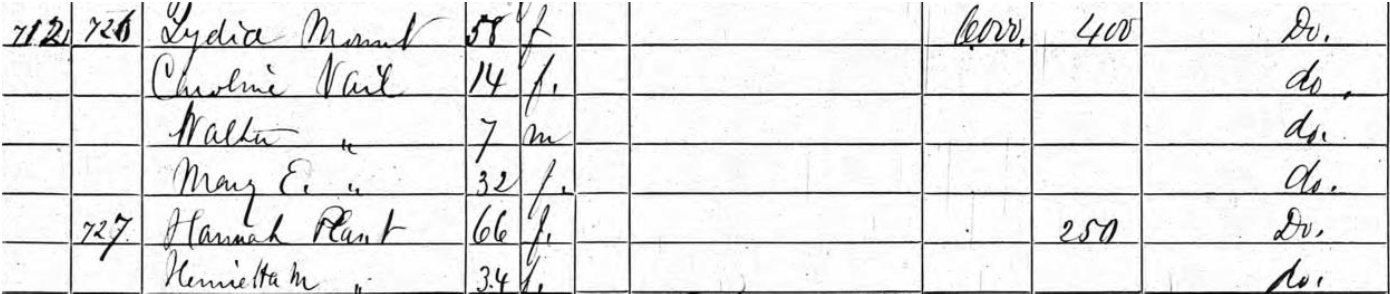
Hannah’s assets are valued at $250, and Lydia’s assets have dwindled considerably since 1850 to $6,400. Hannah is 66, and Henrietta is 34.
Probably mistaking her first name for “Anna,” Hannah Plant is listed as residing at 100 William Street in Brigham’s 1862 directory (40). This spot corresponds to the residence identified as the “Mount House” in an 1852 map of Waterloo.

Hannah's sister Lydia Mount died in 1868. In the 1870 census, Hannah, 74, and Henrietta, 38, live together in Waterloo. Hannah is listed “Keeping house,” and her estate is valued at $2,700. 
I could find no direct source regarding Hannah Plant’s death or information about her place of burial. It seems Signer #26's passing went largely unrecorded at the time of its occurrence. An obituary for Henrietta from 1883 remembers that her mother had died nine years prior—so, around 1874.
Supporting this dating, Henrietta lives without her mother in an 1874 Seneca County directory. Her home is listed as Elisha Street near Church in Waterloo (Evans and Crofoot 182). In another 1879 local directory, Henrietta’s address remains at the same location (Lamey 335).
Henrietta passed away in 1883 at age 57. According to The Seneca County Courier, her funeral was held in Auburn at the home of Enos Laney, Mary E. Vail’s second husband (“Waterloo News”). The Seneca County News reports that Henrietta died “Thursday, March 1st, at the residence of Mr. James Gillilan, about two miles from the West Fayette station.” Henrietta “had been living there for several months, and died of heart disease, after an illness of about four weeks.” She “was the daughter of the late Henry U. Plant of this village who died nearly forty years ago.” Regarding her mother, “Mrs. Hannah Plant died about 9 years ago….being among the early settlers of this village.” Henrietta was a parishioner of St. Paul's Church (“Waterloo Local”). The Waterloo Observer relates that Henrietta died as a result of heart disease and “dropsy,” an antiquated term for edema or fluid retention in the limbs (“Town”). Like her mother, I could find no account of Henrietta’s burial location. It stands to reason that Hannah and Henrietta are interred near Henry’s headstone at the Quaker cemetery in Waterloo. Alternatively, they might be at Maple Grove Cemetery in Waterloo with other Hunt family members.
It is a remarkable fact of American history that an elderly Aaron Burr dropped by the home of Signer #26, two decades prior to her participation in the Seneca Falls Convention. Hannah Plant was likely well acquainted with the ailing, disgraced third vice president of the United States. Notwithstanding a few tantalizing clues, the exact nature of Burr's legal interest with the Plant family is unclear. There was evidently some inheritance money that Burr was responsible for transferring to living beneficiaries. That anyone would trust Aaron Burr as an estate lawyer defies common sense.
This chance meeting supplies a crucial connecting link between the Founding Fathers and the signers of the Declaration of Sentiments. It is reason enough to search for additional ties between the individuals who took part in the American Revolution and the individuals who took part in the fledgling civil rights movements that followed it. Latter-day activists clearly sought to realize the true meaning of the nation's creed, effected through the revision and amendment of its foundational documents.
I can’t help but observe how Hannah Plant’s connection to a founding father happens to be with the most-blemished, scandal-prone, and reviled founding father. Burr was the founding father who ruthlessly assassinated another founding father. By all appearances, he seems to have been every bit the scoundrel and a compulsive liar. His personal imperfections speak to the imperfections that existed in law and custom after the establishment of the United States. Knowing Aaron Burr on some personal level, the recently widowed Hannah Plant sought to set the record straight at the Seneca Falls Convention.
The son and grandson of College of New Jersey presidents, Aaron Burr lies buried at Princeton ("Aaron Burr"). Hannah Hunt Plant rests in an unmarked grave in some unknown place.
Works Cited
“A. Burr Subpoena to Richard Hunt,” Wikimedia Commons, Accessed 25 Apr. 2025. https://commons.wikimedia.org/wiki/File:A._Burr_subpoena_to_Richard_Hunt_(cf51bdd5c8b747c39288beb7ed24a770).pdf.
"Aaron Burr." Findagrave.com, Accessed 25 Apr. 2026. https://www.findagrave.com/memorial/151/aaron-burr.
“Abigale – Passenger Manifest.” New York Arriving Passenger and Crew Lists. Ancestry.com. Accessed 25 Apr. 2025.
Brigham, DeLancey. Brigham’s Geneva, Seneca Falls, and Waterloo Directory and Business Advertiser, For 1862 and 1863. 1862.
“Disgraceful.” The Schenectady Cabinet, 24 Aug. 1836, p.1.
Evans, William & Wesley Crofoot. Seneca Falls & Waterloo Village Directory, 1874-5. Truair, Smith & Co.
“Henry U. Plant.” Findagrave.com, Accessed 25 Apr. 2026. https://www.findagrave.com/memorial/96220777/henry_ustick-plant.
“Henry U. Plant—Probate Letter.” New York, Wills and Probate Records, Ancestry.com. Accessed 25 Apr. 2025.
“Henry U. Plant—Surrogate’s Letter.” New York, Wills and Probate Records, Ancestry.com. Accessed 25 Apr. 2025. “Jackson v. Chew, 25 U.S. 153 (1827).”
“Hunt-Plant Marriage.” United Methodist Church Records. Ancestry.com. Accessed 25 Apr. 2025.
Hunt, John G. The Descendants of Thomas Hunt, Sr. 1936.
“Jackson v. Chew, 25 U.S. 153 (1827).” Justia.com, Accessed 25 Apr. 2025. https://supreme.justia.com/cases/federal/us/25/153/.
Kreisman, Polly. “A Look at Aaron Burr’s History in Westchester County.” Westchester Magazine. Accessed 25 Apr. 2026. https://westchestermagazine.com/life-style/aaron-burr-westchester/.
Lamey, Alonzo. The Auburn, Seneca Falls and Waterloo Directory! 1879.
“Letter—Henry U. Plant to Richard Hunt, October 1828.” Wikimedia.org. Accessed 25 Apr. 2026. https://upload.wikimedia.org/wikipedia/commons/1/1e/Henry_U._Plant_letter_to_Richard_Pell_Hunt_%281b68c2de9e0e40faa8b922e0a67a75b7%29.pdf.
“Letter—Henry U. Plant to Richard Hunt, July 1829.” National Park Service, Accessed 25 Apr. 2026. https://npgallery.nps.gov/AssetDetail/df8a9931-5f8a-4846-a2aa-b621b6e0b9a7.
“Married.” The New York Evening Post. 26 Apr. 2023, p. 1. Fultonhistory.com.
“Married.” The New York Spectator, 24 Apr. 2023. Fultonhistory.com.
"Mortgage Indenture--Hannah Plant." Abebooks, Accessed 25 Apr. 2025. https://www.abebooks.co.uk/Mortgage-Indenture-WestChester-New-York-Hannah/32186625093/bd.
“Mount Household.” Federal Census, 1850. Waterloo, Seneca County, New York. Ancestry.com, Accessed 25 Apr. 2026.
“Mount Household.” Federal Census, 1860. Waterloo, Seneca County, New York. Ancestry.com, Accessed 25 Apr. 2026.
“Plant Household.” Federal Census, 1840. Seneca Falls, Seneca County, New York. Ancestry.com, Accessed 25 Apr. 2026.
“Plant Household.” Federal Census, 1870. Waterloo, Seneca County, New York. Ancestry.com, Accessed 25 Apr. 2026.
Quinby, Henry Cole. Genealogical History of the Quinby (Quimby) Family in England and America. 1915.
Sneff, Emily. "Founding Fathers?" Declaration Resources Project, https://declaration.fas.harvard.edu/blog/december-founders. Accessed 25 Apr. 2025.
“Town Topics.” The Waterloo Observer, 7 Mar. 1883, p. 4.
“Waterloo Local.” Seneca County News, 6 Mar. 1883, p. 3.
“Waterloo News of the Week.” Seneca County Courier, 8 Mar. 1883. https://fultonhistory.com.
Wellman, Judith. The Road to Seneca Falls: Elizabeth Cady Stanton and the First Woman’s Rights Convention. University of Illinois Press, 2010.
Wilson, Edith W. Bowne Family of Flushing Long Island. William Byrd Press, 1948.
Wood, Gordon S. “The Real Treason of Aaron Burr.” Proceedings of the American Philosophical Society, vol. 143, no. 2, 1999, pp. 280–95.